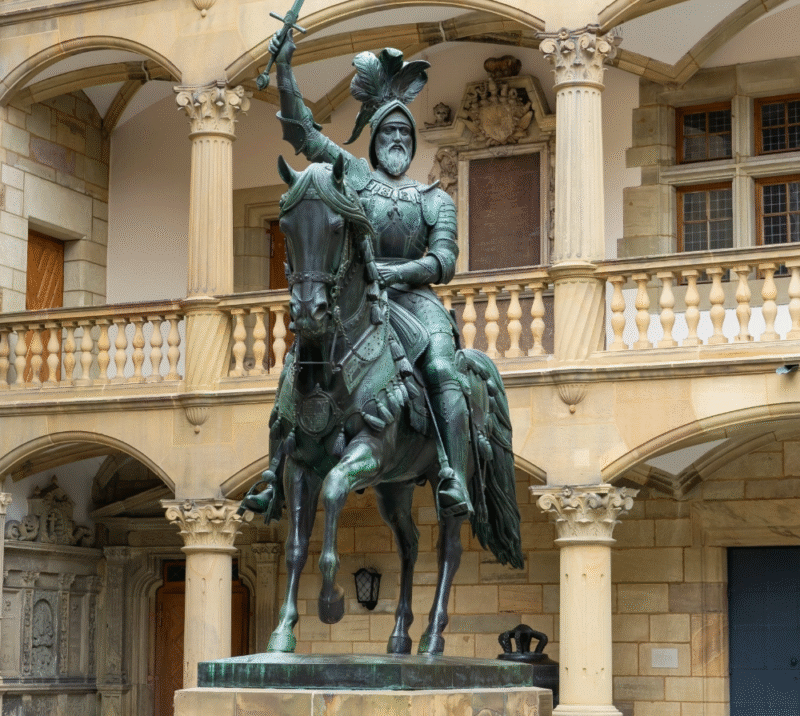
Reading:
1 Samuel 17:38-40:
38 So Saul clothed David with his armour, and he put a bronze helmet on his head; he also clothed him with a coat of mail. 39 David fastened his sword to his armor and tried to walk, for he had not tested them. And David said to Saul, “I cannot walk with these, for I have not tested them.” So David took them off. 40 Then he took his staff in his hand; and he chose for himself five smooth stones from the brook, and put them in a shepherd’s bag, in a pouch which he had, and his sling was in his hand. And he drew near to the Philistine.
Question:
What are the implications of this story, about David rejecting Saul’s armour and going to fight with a sling and stones, on our life? It’s about adopting the things of other people as distinct from what God tells you to do, e.g. second hand theology.
Reflection:
Saul’s armour was the best available standard of military practice of that day. But David had the lived experience of relying on God alone to face the worst dangers of this wild world, and he had learnt to be obedient to God’s leading.
Like David, we have the lived experience of faith, of trusting in God and learning to be obedient to His leading. But it’s easy to see around us ways in which we can be tempted to put on the armour of the accepted best practice of our day.
We can apply good business models to worship, with key performance indicators, efficiency measures, and even indexes that tell us when a church should be closed down. And if Blackwood Hills had followed this practice our church would no longer exist!
Or we can adopt a polished sales approach, to make the message persuasive and appealing without requiring self-reflection, keeping it short and superficial to give it broad appeal. That tends to turn the gospel into techniques for solving our personal problems, of how to adopt a winning formula in our lives – which is totally self-directed, it’s similar to other secular self-help material.
Or we can put on the visible apparatus of worship. Lofty cathedrals can effectively redirect our focus away from everyday material concerns to what lies beyond. Choral music can be similarly uplifting. And some of the fine words used in the liturgy and set prayers of traditional churches can remove stress and bring calm and rest. If that’s all it does, then it is similar to meditation, a gym workout, or a walk at the beach. These things can make worship a refreshing experience, but if they remain as external activities, they leave us basically unchanged, still facing the dilemma of fallen mankind. But if these activities are the beginning of a change in our direction, and start us on a journey of humble rempentance before God, they can be valuable in helping to trigger a turning point that is life-changing.
A person I knew many years ago declared that because the set liturgy was God’s word, then the speaking of it in worship was a “means of grace”, a part of God’s process of forgiveness and salvation. To me, such worship felt like an external or mechanical suit of armour, a way of going through the motions to get what we want. I think that trusting in liturgy is similar to trusting in good deeds.
Our life journey and our circumstances are unique before God, we are special before Him. His infinite love is overflowing to us, as if we were the only person in His view. He has saved us in His grace to follow His path, to do the wonderful and unique activities he has prepared for us. This demands a personal relationship with God with armour that is invisible.
As outlined in Ephesians 6:13-17, it allows us to stand against the rulers of darkness of this age, against spiritual hosts of wickedness in the heavenly places. We are to girde our waist with truth, put on the breastplate of righteousness, shod our feet with the gospel of peace; the shield of faith to quench the fiery darts of the wicked one, and the helmet of salvation, and the sword of the Spirit, which is the word of God;
This armour is given through personal faith in God through Jesus, not through external devices, activities, or traditions.
0 Comments